


On October 20, Dr. Nguyen Hong Lien, Vice President of Thai Nguyen University (TNU), chaired a meeting with a delegation representing universities in the Russian Federation to discuss opportunities for cooperation in education and training, scientific research, and student and faculty exchanges.
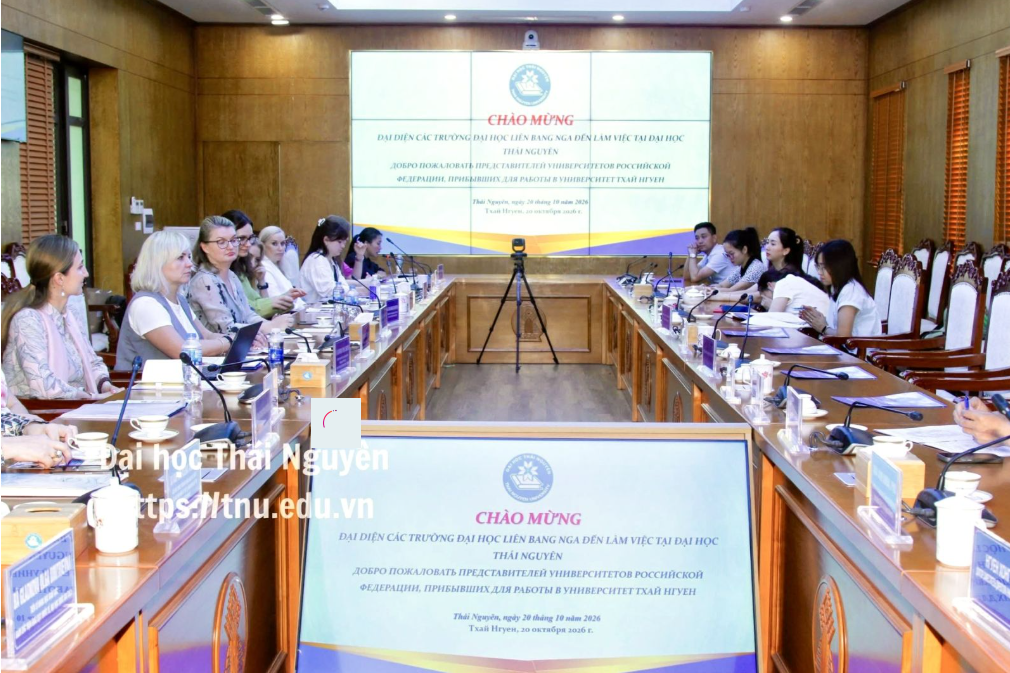
An overview of the meeting.
The delegation comprised representatives from several Russian universities, including Tula State University (TulSU), Saint Petersburg State University of Aerospace Instrumentation (GUAP), Russian State Hydrometeorological University – RSHU, Tomsk State University – TSU, The Herzen State Pedagogical University of Russia, Northern (Arctic) Federal University named after M.V. Lomonosov (NArFU), The Russian University of Medicine (RosUniMed), Saint Petersburg State University of Industrial Technologies and Design (SUTD), Peter the Great St. Petersburg Polytechnic University (SpbPU), Tomsk State University of Control Systems and Radioelectronics – TUSUR, and the Russian Centre of Science and Culture in Hanoi.
Also attending the meeting were representatives of the leadership of TNU’s Department of Science, Technology and International Affairs and Department of Academic Affairs and Student Affairs; staff, lecturers, and students from TNU’s member universities, School of Foreign Languages, and International School; as well as TNU alumni who had previously studied in the Russian Federation.
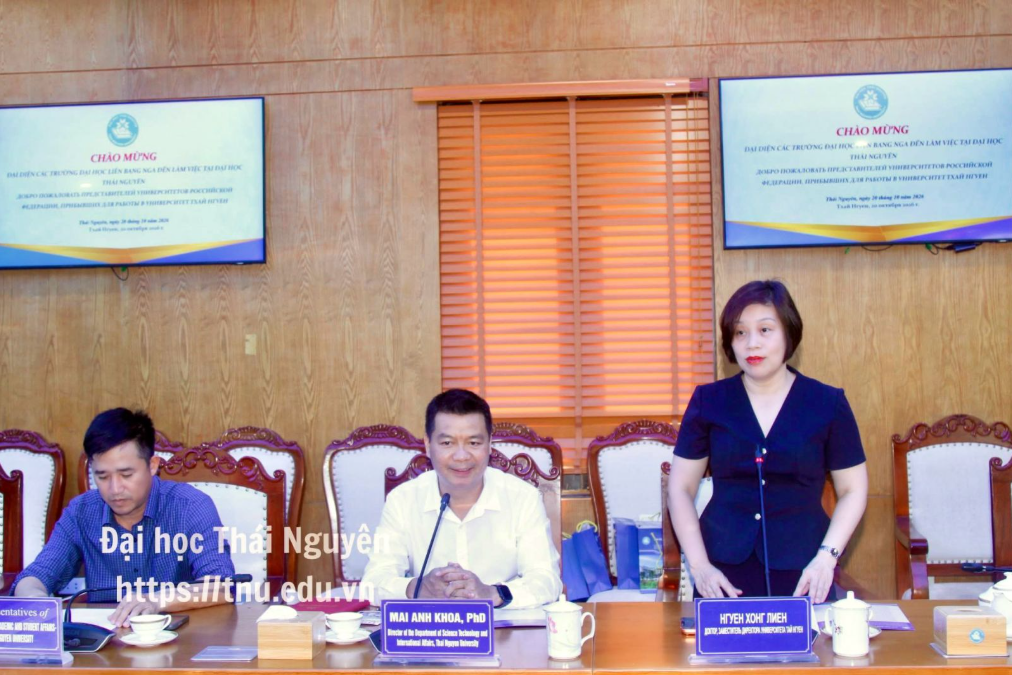
Dr. Nguyen Hong Lien, Vice President of TNU, delivers remarks at the meeting.
In her remarks, Dr. Nguyen Hong Lien provided an overview of TNU’s scale, standing, and development orientations. As one of Vietnam’s key regional universities, TNU offers multidisciplinary education across more than 350 academic programs, with nearly 4,000 staff and lecturers and more than 125,000 students. Approximately 1,000 international students from nearly 30 countries and territories are currently studying at the University.
The TNU Vice President emphasized that the University is actively implementing Politburo Resolutions No. 57-NQ/TW and No. 71-NQ/TW, gradually expanding access to higher education in remote, disadvantaged, and border areas to promote equal educational opportunities. Through its campuses in Lao Cai, Tuyen Quang, and Dien Bien, its centers in Cao Bang, and its plans to develop a campus in Cao Bang, TNU continues to strengthen its role in training and developing high-quality human resources for Vietnam’s Northern Midlands and Mountainous Region and the country as a whole.
Dr. Nguyen Hong Lien affirmed that the longstanding traditional friendship between Vietnam and Russia provides an important foundation for higher education institutions to strengthen connections and expand cooperation in education and research. Building on the respective strengths and development needs of both sides, TNU seeks to promote practical cooperation programs with Russian universities, particularly in student and faculty exchanges, education and research in engineering, strategic technologies, semiconductor technology, information technology, aerospace technology, and other fields in which Russia has strong expertise.
In addition, TNU hopes to expand cooperation in Russian language studies, strengthen academic exchanges among researchers, undertake joint research projects, and create opportunities for Russian experts to participate in teaching, share professional experience, and help improve training quality at the University.
Dr. Nguyen Hong Lien expressed her hope that the discussions would soon be transfered into concrete cooperation programs and activities, strengthening connections between TNU and Russian higher education institutions while further nurturing the friendship between the two countries.
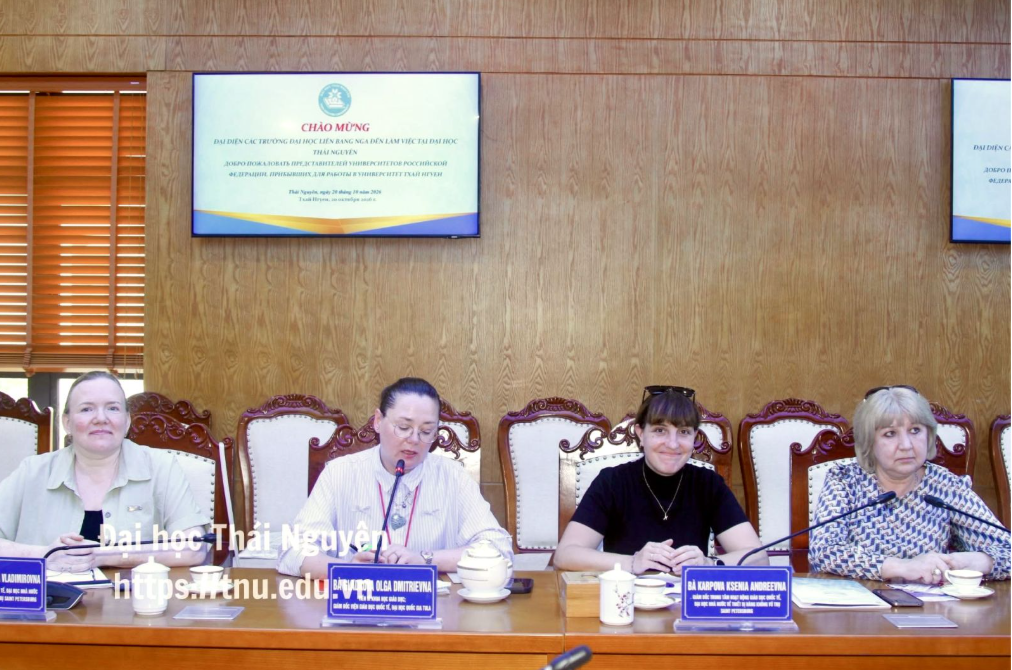
Representatives of the delegation from Russian universities speak at the meeting.
Representatives of the Russian university delegation expressed their appreciation for TNU’s warm and thoughtful hospitality and spoke highly of the potential for cooperation between the institutions. Delegates expressed their desire to strengthen information sharing, establish institutional partnerships, and soon implement bilateral cooperation programs, particularly in student and faculty exchanges, academic engagement, and the development of training programs aligned with each university’s strengths.
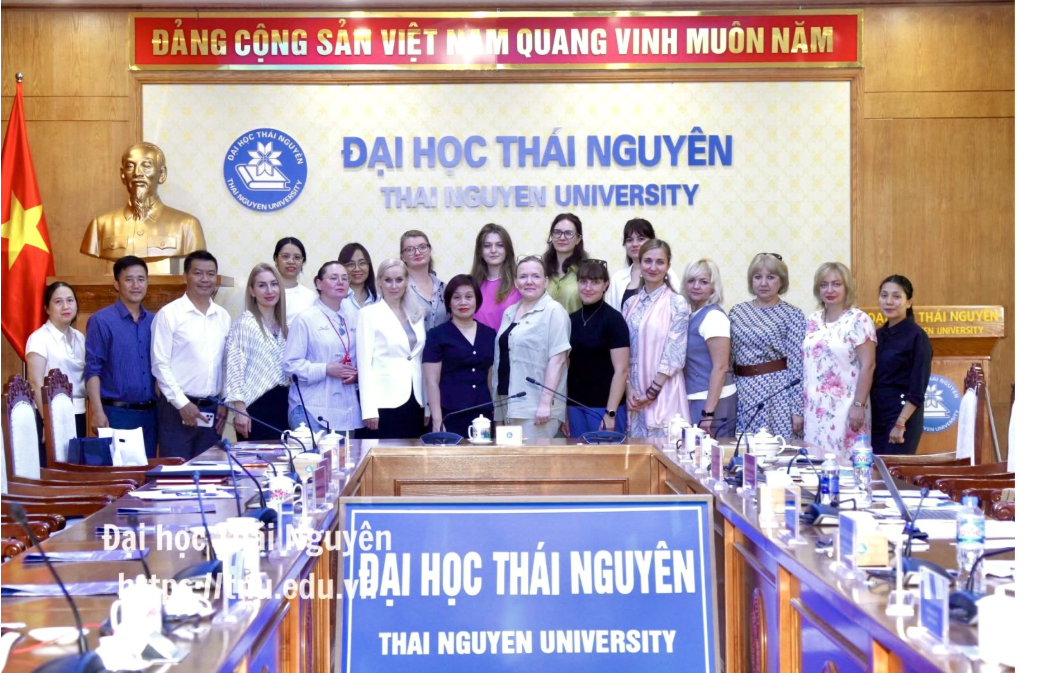
Delegates pose for a commemorative photo.
As part of the program, the delegation introduced their universities, academic disciplines, and educational programs to TNU students. The activity provided students with greater access to information about international study and exchange opportunities while opening up new prospects for cooperation in education and human resource development between TNU and its Russian partners in the coming years.


